
14.2 Artifical Neural Network (Homebrew with OpenAI refactoring)#
This section revisits the homebrew neural network example, but with improvements generated through OpenAI-assisted refactoring. The goal was to:
Modularize code into logical groups
Apply best programming practices (where practical)
Improve error handling in the file download block
Add in-line documentation to improve readability and maintainability
Reset the runtime environment prior to execution using
%reset -f
This modularized structure forms the foundation for subsequent refactoring into a package-based solution.
Note
The goal remains the same as before: we start with a working scaffold, then use modern tools — in this case, OpenAI — to improve the structure, enforce best practices, and reduce development time. While we could make these refinements manually, the time savings allows us to focus on the substantive tasks rather than getting bogged down in programming nuances.
As emphasized earlier in the course, we still need to understand the structure of the code, interpret its behavior, and identify errors when they arise — so we can ask the right questions and request meaningful corrections. This human–AI–human cycle produces a useful, interpretable tool more quickly than working alone.
%reset -f
import numpy as np
import scipy.special  # Sigmoid activation function
import requests
import os
import imageio.v2 as imageio
import matplotlib.pyplot as plt
# ----------------------------
# 1. Dataset Retrieval Function
# ----------------------------
def download_file(url, filename):
    """Download a file from a URL if it does not exist locally."""
    if not os.path.exists(filename):
        r = requests.get(url, allow_redirects=True)
        with open(filename, "wb") as f:
            f.write(r.content)
        print(f"Downloaded: {filename}")
    else:
        print(f"File already exists: {filename}")

# URLs for MNIST dataset
mnist_train_url = "http://54.243.252.9/engr-1330-psuedo-course/CECE-1330-PsuedoCourse/6-Projects/P-ImageClassification/mnist_train.csv"
mnist_test_url = "http://54.243.252.9/engr-1330-psuedo-course/CECE-1330-PsuedoCourse/6-Projects/P-ImageClassification/mnist_test.csv"

# Download datasets
download_file(mnist_train_url, "mnist_train.csv")
download_file(mnist_test_url, "mnist_test.csv")
File already exists: mnist_train.csv
File already exists: mnist_test.csv
# ----------------------------
# 2. Neural Network Class
# ----------------------------
class NeuralNetwork:
    def __init__(self, input_nodes, hidden_nodes, output_nodes, learning_rate, verbose=True):
        self.inodes = input_nodes
        self.hnodes = hidden_nodes
        self.onodes = output_nodes
        self.lr = learning_rate
        self.verbose = verbose

        # Initialize weight matrices with values between -0.5 and 0.5
        self.wih = (np.random.rand(self.hnodes, self.inodes) - 0.5)
        self.who = (np.random.rand(self.onodes, self.hnodes) - 0.5)

        # Activation function: Sigmoid
        self.activation_function = lambda x: scipy.special.expit(x)

    def train(self, inputs_list, targets_list):
        """Train the neural network using backpropagation."""
        inputs = np.array(inputs_list, ndmin=2).T
        targets = np.array(targets_list, ndmin=2).T

        hidden_inputs = np.dot(self.wih, inputs)
        hidden_outputs = self.activation_function(hidden_inputs)

        final_inputs = np.dot(self.who, hidden_outputs)
        final_outputs = self.activation_function(final_inputs)

        output_errors = targets - final_outputs
        hidden_errors = np.dot(self.who.T, output_errors)

        self.who += self.lr * np.dot((output_errors * final_outputs * (1.0 - final_outputs)), hidden_outputs.T)
        self.wih += self.lr * np.dot((hidden_errors * hidden_outputs * (1.0 - hidden_outputs)), inputs.T)

    def query(self, inputs_list):
        """Query the network for predictions."""
        inputs = np.array(inputs_list, ndmin=2).T
        hidden_inputs = np.dot(self.wih, inputs)
        hidden_outputs = self.activation_function(hidden_inputs)
        final_inputs = np.dot(self.who, hidden_outputs)
        final_outputs = self.activation_function(final_inputs)
        return final_outputs
# ----------------------------
# 3. Helper Functions
# ----------------------------
def load_data(filename):
    """Load dataset from a CSV file."""
    with open(filename, 'r') as f:
        return f.readlines()

def normalize_inputs(all_values):
    """Normalize input values from 0-255 to a range of 0.01 to 1.00."""
    return (np.asarray(all_values[1:], dtype=np.float64) / 255.0 * 0.99) + 0.01

def train_network(model, data, epochs=1, manual_lr_decay=True):
    """Train the neural network over multiple epochs."""
    for _ in range(epochs):
        for record in data:
            all_values = record.split(',')
            inputs = normalize_inputs(all_values)
            targets = np.zeros(model.onodes) + 0.01
            targets[int(all_values[0])] = 0.99
            model.train(inputs, targets)
        if manual_lr_decay:
            model.lr *= 0.9  # Manual learning rate scaling
    if model.verbose:
        print("Training complete!")

def evaluate_network(model, data):
    """Evaluate the model on test data."""
    scorecard = []
    for record in data:
        all_values = record.split(',')
        correct_label = int(all_values[0])
        inputs = normalize_inputs(all_values)
        outputs = model.query(inputs)
        label = np.argmax(outputs)
        scorecard.append(1 if label == correct_label else 0)
    accuracy = sum(scorecard) / len(scorecard)
    print(f"Model Accuracy: {accuracy * 100:.2f}%")

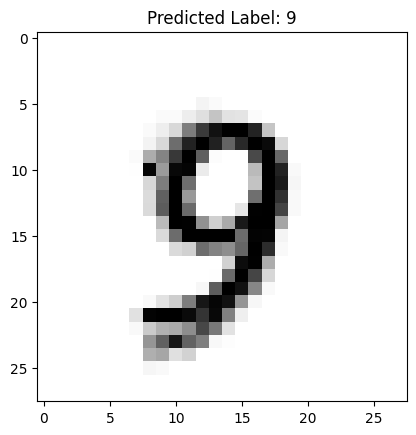
def classify_and_display_image(model, image_path):
    """Classify a new image and display it with the predicted label."""
    img_array = imageio.imread(image_path, mode='F')
    img_array = np.max(img_array) - img_array  # Invert colors
    img_data = (img_array / 255.0 * 0.99) + 0.01
    output = model.query(img_data.flatten())
    label = np.argmax(output)

    plt.imshow(img_array, cmap='Greys')
    plt.title(f"Predicted Label: {label}")
    plt.show()
    return label
# ----------------------------
# 4. Model Initialization & Training
# ----------------------------
input_nodes = 784  # 28x28 pixels
hidden_nodes = 110  # Intermediate hidden layer size
output_nodes = 10  # 10 classification labels
learning_rate = 0.1

# Create neural network instance
n = NeuralNetwork(input_nodes, hidden_nodes, output_nodes, learning_rate, verbose=True)

# Load training and test data
training_data = load_data("mnist_train.csv")
test_data = load_data("mnist_test.csv")
# Train the network
train_network(n, training_data, epochs=3)
Training complete!
# Evaluate performance
evaluate_network(n, test_data)
Model Accuracy: 96.36%
classify_and_display_image(n, "./image_src/MyNine.png")
np.int64(9)